



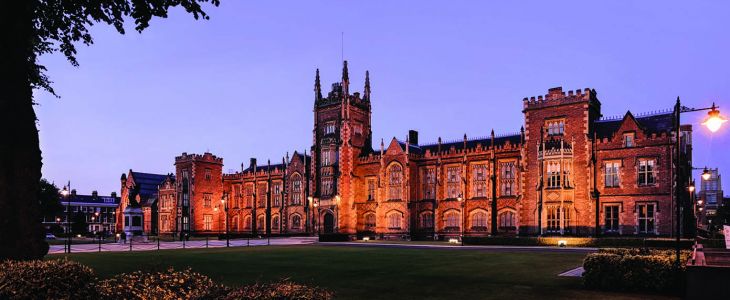

Queen’s University Belfast
Queen’s University Belfast offers an inspiring place to learn, where historic buildings meet bright, modern spaces. The campus feels both welcoming and full of possibility, inviting you to explore new ideas. Set within a friendly, creative city, it’s a community that supports your curiosity and encourages you to grow. Here, you’re not only welcomed—you’re prepared to become a future-ready graduate, equipped for whatever path you choose next.
STUDY AT THE sCHOOL OF lAW at QUEEN’S UNIVERSITY, BELFAST
Studying Law at Queen’s University Belfast offers students access to a modern, purpose-built School of Law located in the centre of the campus. Facilities include an interactive Moot Courtroom, dedicated teaching and study spaces, and areas designed to support student wellbeing and community engagement. The academic staff bring expertise across a wide range of legal fields, including human rights, public and private law, criminology, transnational law and comparative legal studies. Many are recognized internationally and contribute to research with practical, societal impact.
The School’s research activity is supported by an environment built on collegiality, vitality and sustainability. Its academic community engages in interdisciplinary work with research hubs and university-wide institutes that examine themes such as peace, justice and security. This collaborative approach links legal fields across the arts, humanities and social sciences, encouraging cross-faculty projects that address complex national and global issues. Engagement with public bodies, the legal profession, NGOs and community organizations helps ensure that the School’s research contributes meaningfully to public debate and policy development at multiple levels.
Students benefit from a learning approach that blends lectures, seminars, tutorials and independent study with opportunities for practical experience. Mooting, alternative dispute resolution projects, Street Law initiatives, student-led journals and public engagement activities allow students to develop advocacy, communication and analytical skills in real-world contexts. Teaching encourages critical thinking, legal reasoning and reflection on law’s role in society, supporting students to explore both doctrinal and socio-legal perspectives. Postgraduate researchers are integrated into the School’s academic culture through structured supervision, research training, seminars and participation in committees and research centres.
The wider student community is diverse, with students from the local region, across the UK and from many international backgrounds. Student societies connected to the School create opportunities for collaboration, networking and peer support, contributing to a strong sense of community. The School’s long-established culture of outreach includes public lectures, conferences, research networks and active involvement with legal and civic institutions. Long-standing centres, such as the Human Rights Centre, connect students and academics with practitioners and scholars working on contemporary human rights issues.
Queen’s University Belfast places emphasis on sustainability and social responsibility across its teaching, research and campus operations. This aligns with the School of Law’s engagement in areas such as human rights, transitional justice, social policy and global legal challenges, enabling students to link their legal studies to broader societal concerns. Graduates develop analytical, research and communication skills that support progression into a wide range of careers, including legal practice, public service, policy work, business, community advocacy and academic research.
Studying Law at Queen’s University Belfast, you’re not just trained in legal doctrine — you’re equipped with critical thinking, research skills, advocacy experience, and a global mindset. Whether you aim for a traditional legal career — solicitor, barrister, compliance or public-service roles — or want to branch into business, policy, diplomacy, research or social justice work, the degree’s flexibility and the community’s support prepare you for many paths.
HISTORY of the school of law at QUEEN’s university belfast
Queen’s University Belfast traces its origins to 1845, when it was founded under royal charter as Queen’s College Belfast. It formed part of a group of colleges created to broaden access to higher education beyond the denominational institutions then dominant in Ireland. The landmark Lanyon Building, designed by Sir Charles Lanyon and now central to the campus, was completed a few years later and remains one of the University’s most recognizable features.
In 1908, the college was reconstituted as an autonomous institution under the name Queen’s University of Belfast. As an independent university, it expanded steadily beyond its original academic foundations in Arts, Medicine and Law, gradually developing a wider range of disciplines in response to social, economic and scientific change.
Over time, the University has grown significantly in size and scope. The campus now incorporates a mix of historic buildings and contemporary facilities, reflecting both its heritage and its ongoing development. The student community has evolved into a diverse, multicultural population, demonstrating the continuity of student life across generations.
What This History Offers Prospective Students
This long history provides a distinctive academic environment where tradition and modernity coexist. Students experience a campus shaped by nearly two centuries of education, research and civic engagement, while benefiting from facilities and programmes designed for contemporary study and global opportunities. Joining Queen’s means becoming part of a university that has continually adapted to meet new challenges — and contributing to the next stage of its story.
Areas of Legal expertise at the school of law QUEEN’S university belfast
The School of Law at Queen’s University Belfast has a broad and internationally recognized research reputation, covering areas such as human rights and public law, criminology and criminal justice, private and commercial law, European and transnational law, transitional justice, and law, innovation and technology. Its location in Northern Ireland provides unique opportunities to study law within a post-conflict society, in the context of devolved government, local justice systems, and regional social and political dynamics.
Teaching combines lectures, tutorials, and independent study with practical experiences including moot courts, alternative dispute resolution, Street Law projects, and student-led journals, enabling students to develop advocacy, research, and problem-solving skills. Postgraduate researchers benefit from structured supervision, training workshops, and opportunities to contribute to high-impact interdisciplinary and international research.
The School’s distinctive strengths in law, innovation and technology cover areas such as AI, automation, data protection, medical law and ethics, intellectual property, and environmental regulation. Long-established expertise in human rights, transitional justice, and public law draws on both local history and global developments, allowing students to engage with issues such as civil liberties, conflict legacy, social justice, and inequality. Research is methodologically diverse, encompassing doctrinal, socio-legal, critical, historical, comparative, and interdisciplinary approaches, giving students the opportunity to study complex issues from multiple perspectives.
Strong professional connections with government bodies, NGOs, legal institutions, and international organizations ensure students experience law in real-world contexts, preparing them for careers in legal practice, public service, policy, advocacy, and research.
LIFE ON CAMPUS AT QUEEN´S UNIVERSITY belfast
The School of Law is located in a modern, purpose-built building at the heart of Queen’s main campus, embedded within Belfast’s vibrant Queen’s Quarter so students enjoy the convenience of urban life while being part of a green, historic campus environment. The campus combines green, historic spaces with contemporary facilities, giving students a mix of heritage architecture and state-of-the-art study environments.
Living and studying at Queen’s means you’re never far from cafés, shops, restaurants — part of the lively student-friendly streets around the Queen’s Quarter and near Botanic Gardens, Ulster Museum and other Belfast-city amenities.
The proximity to Belfast city centre means everyday conveniences (food, social life, local transport) are very accessible, making campus life active both on and off-campus.
Student and Community Life
Queen’s hosts a diverse student body from Northern Ireland, the UK, and around the world, creating a multicultural and globally aware environment. Students can join a variety of societies and initiatives linked to the School of Law, including the Law Society, Mooting Society, Alternative Dispute Resolution Society, Street Law projects, student-run journals, podcasts, and Women in Law events. These opportunities foster collaboration, practical experience, and engagement with real legal challenges beyond the classroom.
A Day in the Life of a Law Student
Law students at Queen’s combine academic study with hands-on experiences. A typical day may include attending classes or moot courts, using the Law Building’s digital studio for presentations or podcasts, studying individually or in groups, and socializing on campus.
Outside the classroom, students can work out at the gym, join a club or society through the Students’ Union, participate in Law podcasts, catch a film at the Queen’s Film Theatre, stroll through Botanic Gardens, visit the Ulster Museum, explore cafés and shops along Botanic Avenue, or immerse themselves in Belfast’s vibrant arts, music, and nightlife—all within walking distance.
STUDENT SUPPORT AT the school of law at QUEEN’S university belfast
At Queen’s, student support is an integral part of the university experience. The Law School works alongside university services to ensure students receive guidance, advice, and practical help across a wide range of areas.
Academic Support: Students can access help with study skills, essay writing and exam preparation. Law students benefit from tailored sessions for mooting, advocacy, and legal research, supported by dedicated academic advisors and supervisors familiar with the Law School’s programmes and competitions.
Personal and Wellbeing Support: Counselling services, mental health support, and peer mentoring are available, allowing students to discuss personal or academic challenges in confidence.
Financial Guidance: Advice is provided on budgeting, managing fees, and exploring scholarships and bursaries. For the latest information on financial support, including awards for international students, prospective students are encouraged to contact Across the Pond for expert guidance.
Language and International Student Support: Students whose first language is not English can access language workshops, writing support, and conversation groups. International students benefit from orientation events, visa and immigration advice, housing guidance, and social or cultural integration programmes to help them settle in.
Law School-Specific Guidance: Additional support includes employability modules, career mentoring and networking opportunities specific to the legal profession, including guidance on placements, and/or internships. Industry experts and Top International Law Firms are regular visitors to the Law School. Workshops and resources are available for students preparing for professional accreditation in their home countries—for example, Canadian students can receive guidance on the NCA (National Committee on Accreditation) process, including optional summer study programmes for exam preparation.
In short, studying law at Queen’s means students have access to a comprehensive support network, covering academic, personal, professional, and practical needs, ensuring they can focus on learning and development throughout their time at the University.
facilities at the school of law QUEEN’S UNIVERSITY belfast FACILITIES
The Law School provides an environment where theory meets practice, combining modern teaching spaces with purpose-built facilities to give students a professional, real-world learning experience.
Teaching Buildings:
Housed in a contemporary building at the heart of the main campus, the Law School features bright, flexible classrooms equipped with modern audio-visual technology, including interactive whiteboards, projection systems, and recording facilities. Small-group seminar rooms support discussion-based learning, while open-plan areas encourage collaboration and group study.
Specialist Law Facilities:
- Moot Courtroom: A full-scale, professionally designed courtroom allows students to practice advocacy, trials, and mooting in realistic settings, developing confidence and practical legal skills.
- Law Clinic: Students gain hands-on experience working on real cases under supervision, providing advice to members of the public and engaging in social justice initiatives.
- Dedicated Law Library: A library specifically for law students offers a comprehensive collection of legal texts, journals, and electronic resources, along with quiet study areas and group rooms.
Study and Revision Spaces:
In addition to the Law Library, students can access the McClay Library, the University’s central study facility, which offers thousands of study spaces, private booths, group rooms, computer facilities, and online resources. Campus includes a variety of quiet zones, social study areas, and informal collaboration spaces, allowing students to choose the environment that best suits their learning style.
law societies and sports at QUEEN’s university belfast
Life Outside the Classroom at Queen’s University Belfast
Life at Queen’s is diverse, inclusive, and full of opportunities for students to explore interests, develop skills, and build lasting friendships. The Student Union, societies, and sports clubs form the heart of campus life, supporting an active and engaging student community.
Student Union (QUBSU):
The Student Union is a student-run hub where social life, support, and leadership intersect. Elected student officers represent the student body and help ensure student voices are heard on campus and beyond. The Union hosts a wide variety of events, including concerts, comedy nights, cultural festivals, city trips, and career-focused workshops. Students can also get involved directly by volunteering, joining committees, or organizing events, gaining leadership and teamwork experience.
Societies:
Queen’s offers hundreds of student-led societies covering academic, cultural, political, creative, and social interests. Law students can join the Queen’s Law Society, which organizes networking events, guest lectures, mooting competitions, and social activities.
There is also a Canadian Law Society, providing support for Canadian students, guidance on professional accreditation such as NCA preparation, and networking opportunities. Law students often participate in debating, politics, volunteering, and cultural societies, while international students can join nationality-specific groups, like the Canadian Society. Societies are a key way to make friends, gain leadership experience, and enhance employability.
Sports:
Sports are a major part of life at Queen’s, with lots of clubs catering to all skill levels—from rugby, football, hockey, and basketball to rowing, climbing, martial arts, and yoga. Facilities include the Physical Education Centre with a fully equipped gym, indoor courts, swimming pool, climbing wall, and fitness studios, complemented by outdoor pitches, courts, and tracks. Students who live in Queen’s accommodation have complimentary access to the PEC (off peak hours). Students can participate in beginner-friendly sessions, recreational leagues, or competitive inter-university competitions across the UK and Ireland. Special events, such as Varsity Week, celebrate sporting achievement and student engagement. Sports provide a way to stay fit, relieve stress, make friends, and experience teamwork and competition.
Together, the Student Union, societies, and sports clubs create a vibrant, inclusive, and supportive environment, helping students make the most of their time at Queen’s both academically and socially.
ACCOMMODATION AT QUEEN’S university belfast
Queen’s offers a variety of accommodation options designed to suit undergraduate, postgraduate, and mature students. Residences are located on or close to the main campus, generally within walking distance of teaching buildings, including the Law School, making lectures, libraries, and campus facilities easily accessible. Options include catered and self-catered arrangements, with single rooms, en-suite rooms, shared flats, and studio apartments available depending on the residence.
Accommodation is open to all students, and international students who apply before a specific deadline are guaranteed a room. The fee is all inclusive and includes utilities such as gas, electricity, and Wi-Fi, with 24/7 security and a residential team across all residences. Cleaning is included in catered options, while self-catered accommodation usually provides shared cleaning of communal areas.
Room and Flat Facilities:
- Bedrooms: Single rooms or studios, with either en-suite or shared bathrooms.
- Shared Flats: Small flats with fully equipped kitchens, communal living and dining spaces.
- In-room amenities: Bed, desk, chair, wardrobe, and Wi-Fi.
- Common areas: Lounges, study spaces, communal kitchens, and recreational areas.
- Laundry: On-site facilities, typically coin- or card-operated.
- Private Accommodation: For students who prefer private rentals, the Queen’s Accommodation Team offers guidance on safe and suitable options, including tenancy agreements, budgeting, and local neighbourhood advice.
Canadian focus and InterNationalisation AT QUEEN’S university belfast
Queen’s University Belfast is a truly global community, welcoming students from Europe, Asia, the Americas, and beyond. International students contribute to a vibrant campus life, bringing diverse perspectives to classrooms, societies, and research projects. Many find the transition to studying in the UK stimulating and rewarding, supported by a comprehensive system that helps them adapt academically, socially, and culturally.
University Approach to Internationalisation:
Queen’s is committed to creating an inclusive, supportive experience for all international students. Orientation programmes and dedicated international support teams help students settle in, navigate visas and housing, and connect with peers. Additional support includes language assistance, academic guidance, and career-focused workshops to help students thrive academically and professionally.
Canadian Connections:
The Law School has a strong Canadian presence, with students often pursuing legal practice or preparing for accreditation with the NCA (National Committee on Accreditation). Tailored support includes mentorship, guidance on NCA preparation, and advice on how UK legal experience complements Canadian career goals. Canadian students can also engage with the Canadian Law Society, which provides social, cultural, and professional networking opportunities, while broader university initiatives connect them with the wider international student body.
Life as a Canadian Law Student:
Canadian students at Queen’s Law are part of a welcoming, diverse community with access to academic, professional, and cultural support. They often participate in law societies, international networks, and volunteer initiatives, benefiting from a combination of dedicated Canadian guidance and wider internationalisation programmes. This ensures they are well-prepared to pursue legal careers in both the UK and Canada while enjoying a fulfilling student experience.
PROFESSIONAL CONNECTIONS AT QUEEN’S university belfast
Queen’s Law actively prepares students for legal careers by combining academic study with practical experience, networking, and professional engagement.
Work Placements and Experiential Learning:
Students gain hands-on experience through Law Clinics, providing advice to real clients under supervision, and mooting competitions, which develop advocacy, research, and presentation skills in realistic courtroom settings. Opportunities also include placements and internships with law firms, NGOs, government departments, and international organizations.
Networking and Careers:
The Law School hosts guest lectures, workshops, and career-focused events, connecting students with practicing lawyers, judges, policy-makers, and alumni in the UK, Ireland, and internationally. Career fairs and alumni events provide students with professional contacts, mentorship, and insight into different legal pathways. Many opportunities are available from the first year, while competitive mooting, specialized placements, and advanced networking events are often targeted at upper-year students.
International Connections and Canadian Support:
Queen’s Law maintains relationships with legal organizations abroad, offering students access to international career pathways. For Canadian students, the School is familiar with the NCA (National Committee on Accreditation) process, providing guidance on integrating UK legal studies with NCA requirements and optional summer preparation programmes to support accreditation goals. Canadian students can also connect with alumni in Canada or internationally to gain advice and build networks.
Frequency and Accessibility:
Students have frequent opportunities throughout the academic year to participate in clinics, moots, workshops, and networking events, ensuring practical and professional development is embedded throughout their time at Queen’s Law.
Internships and study abroad options AT QUEEN’s university belfast
Queen’s Law encourages students to complement their studies with international experience and practical placements, helping them build a future-ready legal career. Guidance and support are provided to make these opportunities accessible and valuable.
Study Abroad Opportunities:
The Law School supports students in undertaking study abroad semesters at partner universities worldwide. These experiences allow students to explore different legal systems, broaden cultural understanding, and develop global perspectives—skills highly valued in legal careers. Participation is encouraged for students seeking to enhance their learning and build international networks, with opportunities dependent on course structure and year of study.
Work Placements and Internships:
Students receive support in securing placements and internships with law firms, public bodies, NGOs, and international organizations. Opportunities may be paid or unpaid, depending on the organization. The School provides guidance on applications, CVs, interviews, and professional conduct to prepare students for success. These placements allow students to gain real-world legal experience, apply classroom learning, and build professional networks.
Practical Benefits:
Participation in study abroad programmes or placements enhances employability, provides insight into professional practice, and enriches classroom discussions and group work. While opportunities are available across multiple years, advanced placements are typically suited to upper-year students who have developed core legal knowledge.
EMPLOYABILITY AND CAREER OPPORTUNITIES AT QUEEN’S university belfast
Queen’s Law places a strong emphasis on preparing students for life after graduation. Employability is embedded throughout the student experience, combining practical skills training, networking, and career guidance to support entry into the UK legal market, Canadian practice, or international opportunities.
Career Preparation and Support:
Students benefit from career fairs, workshops, and networking events with law firms, government agencies, NGOs, and international organizations. Support includes CV and application guidance, interview preparation, mock assessment centres, and alumni mentoring, connecting students with graduates who provide career insights and professional networking. Canadian students receive tailored guidance on the NCA (National Committee on Accreditation) process, helping align UK legal studies with requirements for practice in Canada.
Practical Experience:
Opportunities such as Law Clinics, mooting competitions, placements, and internships allow students to apply legal knowledge in real-world contexts, develop practical skills, and build professional networks, enhancing confidence and employability.
Alumni Outcomes:
Graduates pursue careers across law firms, government, regulatory bodies, NGOs, international organizations, and academia. Many remain in the UK in legal practice, policy, or corporate roles, while others complete the NCA process and practice law in Canada, demonstrating the degree’s global relevance and flexibility.
Student-Centred Approach:
Career and employability support begins in the first year and intensifies as students approach graduation. Guidance covers career pathways, further study, professional accreditation, and international opportunities, ensuring students are well-prepared for success in their chosen legal careers.
STUDY IN belfast – northern ireland
Living and Studying in Belfast
Queen’s University Belfast is located in the heart of the vibrant Queen’s Quarter, blending leafy green campus spaces with modern facilities and historic architecture. Belfast is a city rich in history and culture.
Students enjoy a dynamic mix of music, theatre, galleries, and festivals, alongside sports, outdoor activities, and easy access to scenic walks, parks, and the nearby coastline. The city is compact and easy to explore on foot, by bike, or using public transport, with excellent links to the rest of the UK and Europe via the airport and transport networks.
Belfast is multicultural, welcoming, and affordable, offering safe neighbourhoods, friendly locals, and a variety of student-focused cafés, shops, and nightlife. Its combination of urban energy, cultural life, green spaces, and historic charm makes Belfast an inspiring and enjoyable place to study law while fully experiencing city life.
Why STUDY AT QUEEN’S UNIVERSITY BELFAST
Prestigious Academic Reputation:
As a distinguished member of the Russell Group, Queen’s is celebrated for high-quality teaching, research excellence, and rigorous academic standards that prepare students for success.
World-Class Research:
Students learn from leading experts across human rights, commercial law, technology law, transitional justice, and more, gaining access to cutting-edge scholarship and opportunities to contribute to impactful research.
Hands-On Learning Environment:
Modern classrooms, a dedicated law library, a full-scale moot courtroom, and law clinics provide practical, professional experiences that bring legal theory to life.
Supportive and Inclusive Community:
Comprehensive academic guidance, wellbeing services, language support, and tailored advice for international and Canadian students ensure every student thrives from day one.
Global Perspective:
Study abroad programmes, international internships, and interdisciplinary collaborations expand horizons and enhance career prospects worldwide.
Career-Focused Opportunities:
Strong connections with law firms, government bodies, NGOs, and an active alumni network help students launch successful careers in the UK, Canada, and beyond.
Vibrant Student Life:
Societies, sports clubs, and the Student Union offer social, cultural, and leadership experiences that enrich life outside the classroom.
Historic and Inspiring Campus:
Iconic heritage buildings and leafy green spaces at the heart of Belfast create a unique and motivating study environment.
Dynamic City Location:
Belfast is culturally rich, student-friendly, safe, and affordable, offering music, arts, sports, and outdoor adventures just steps from campus.
Diverse and Welcoming Community:
A vibrant international student body fosters a multicultural environment where all students feel included, supported, and inspired to achieve their ambitions.



 Webinar
 Event
Event
